Kate Anthony

OTI Europe Ltd | Consultancy, Personal Training and Research for Online Therapeutic Services

   
  • Home
  • About
    • CV
  • Speaker
  • Consult/Supervision
  • Online Therapy Training
  • CPD Specials
  • Coach Courses
  • Work with Young People?
  • COVID 19 Telehealth course
  • Blog
  • Contact
  • Work with DV?

Ordering Training À La Carte

December 15, 2014 by Kate Anthony

I’ve been having a think about how clients need varying levels of support in their lives at different times, and how online services can meet those needs.  Sometimes a forum with no interaction by the client is enough – they can learn from previous posts about how others coped in challenging times. Sometimes, the need steps up to receive communication from another human being about an issue, and this can be done through anonymous support forums or chat rooms. Perhaps an ongoing relationship would be helpful, and a less anonymous contract for therapeutic help would be useful from a trained counsellor or psychotherapist. Perhaps that contract can in turn be stepped up to include face-to-face sessions in-room as part of a blended care package.

In short – the levels of support and contact a person needs is a fluid thing!  So why not also apply this to training?ID-100207606

At the Online Therapy Institute, we pride ourselves on our attitude to training being a personal thing.  Each of our students gets one-to-one mentoring from myself or DeeAnna, depending on what the student wants or needs to learn about (and our training catalogue is extensive and diverse!). We build a personal relationship with each student to ensure their training needs are fully met, and we have found this to be the most enjoyable process in continuing professional development for both parties. Our training model lies in the training relationship being as central to the process as the therapeutic relationship will be to their future client base.  The key to learning is in the writing, and the essence of the learning being valuable comes from the personal mentoring that reflects and builds that learning into a living breathing part of a person’s professional identity.

Our Certified Cyber Facilitator and PGCert trainings are the gold standard of what we do, where students build relationships with us as expert trainers to meet professional needs on their journey to being an online practitioner. A more cost-considerate route is our streamlined versions of this, for example our Certified Cyber Therapist credential where you still get the mentoring relationship with me but at a faster pace!  And to make sure that our students feel happy with the chosen route, costs of any introductory courses are fully met if the student chooses to go on to the gold standard route.

But you know what? Just as sometimes a potential client will only need to surf anonymous forums or blogs for help with their mental health, sometimes a potential trainee just needs some building blocks to discover how much training they need or can afford.  This is why in 2015 I shall be offering my trainings à la carte!  This means you can receive the valuable teaching tools and resources we have developed over the years, but without the one-to-one mentoring.  You can always come back for more at no additional cost, and still get a certificate for CPD validation! It’s a win-win!

DeeAnna already offers this training model for our Certified Intuitive Practitioner course over at the Online AromaTherapy Institute if you want to see it in action – or drop me a comment below for updates in 2015!

🙂

[Image courtesy of Stuart Miles at FreeDigitalPhotos.net]

Fostering the Spark – How Our Students Become Pioneers

October 9, 2014 by Kate Anthony

Flash

One of the most enjoyable aspects of tutoring our courses are the live “vivas” – a chance for DeeAnna and I to talk individually to each of our students.  These talks, held over the telephone, through a videolink, or in a chat room, take place twice during our larger trainings – once at the end of the Foundational Course in CyberCulture and then again on completion of the written work in the Specialist Certificate portion.

We used to call them “oral examinations”, but that seemed very formal for what is essentially a check-in to ensure the learning is being taken on board, to clear up any misunderstandings about the work, and to clarify any parts that may be unclear or need further unpicking.  It is also a chance for us to exemplify our message that communication is at the heart of all we do – whether in a learning environment or working with the clients we serve. To truly model our belief that communication is communication whatever technology we use (including those chairs Douglas Adams talked about), moving away from the written feedback we give at the end of every lesson towards the live conversation and back again allows the concept of the importance of blending technologies to emerge.

But what I really love about these conversations is hearing how the learning is being applied to each student’s work environment – whether a therapist, coach, support worker or other human wellbeing professional.  This gives us a chance to drill down into how the student can take the learning forward, not only for their own ongoing development but for the good of the clients and the wider profession.  I can get flavours of this through our ongoing written dialogue throughout the course, where the ideas the student has take hold and start blossoming – but it is the live conversation that allows not just the brainstorming part between two people, but also the infectious enthusiasm we both get as those ideas start to be fleshed out. There is nothing more satisfying than to hear the course content come to life when the student finds their niche – recent examples have been around how to reach and serve the suicidal client better, the use of blogging for co-education for senior Supervisors, the creation of a virtual gallery for those interested in showcasing art therapy techniques, and how best to de-stigmatise mental health services for children and young people.

The students on our courses are the pioneers of the profession.  Sure, we give them the tools to work effectively and ethically online, and I honestly applaud any practitioner who seeks the training so necessary to do so (whether they are trained with us and the Online Therapy Institute or not).

But it is hearing the spark igniting the fuse towards meaningful ground breaking online work as each student applies the technology that makes my day during these vivas. Fostering that spark and helping to turn it into a realistically better way to be present for our colleagues and clients in any therapeutic field is intensely satisfying for us as tutors and mentors. It’s simply a privilege to see how our courses can startle a new thought into action for each and every student who joins us.

🙂


Gaming online – when does it turn into a diagnosable psychiatric disorder?

October 1, 2014 by Kate Anthony

I have a special interest in this field, not only as part of my work in general but as an avid gamer myself.  With the exception of World of Warcraft (more on that later), I’ve pretty much run the gamut of gaming, from the Atari’s Pacman and Space Invader games back in the 70s right through the Legend of Zelda suite to the current rash of mobile and Facebook time-sucks (I use that term fondly) such as Bubble Witch Saga 2 and Candy Crush.

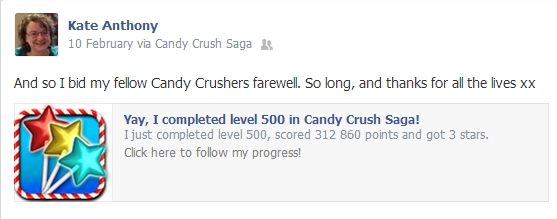
And I can truthfully say that Level 500 of CCS sucks:

cc

Recently a group of researchers tackled the controversial fact that the DSM-V includes non-substance addiction as a psychiatric diagnosis, in the journal Addiction.  This is a very welcome paper, not least because the DSM-V has pretty much sidelined the concept of general Internet addiction in favour of the specific behaviours conducted over the Internet. This has wide implications for various online addictions, including gambling, sex and virtual reality environments.

I found the recent showing in the UK of Web Junkie riveting – of course I was aware of the gaming boot camps in China, but watching the participants discuss their use of nappies to ensure they didn’t miss a minute of the game for their hygienic needs really brought home the huge problems gaming can cause.  These boot camps cost twice the parent’s average monthly income to attend – it is apparently never voluntary and often involves subterfuge to get the young people there in the first place.  Indeed, when a group of the boot camp members “escaped”, they headed straight for the nearest Internet Cafe to play for four hours before being “caught”.  Many cite combating loneliness as one of the main attractions.

I took one look at the game World of Warcraft when at a friend’s house, and vowed never to touch it.  The appeal of those beautiful graphics, the team-playing, the role-playing, the social side of like-minded people banding together to defeat obstacles and missions…  what’s not to like if you are an avid gamer?  My gaming colleagues and friends (you know who you are) have tempted me over the years – but WoW is a time-suck too far for someone who already has mild(ish) issues with online gaming.  I have almost (almost) sacrosanct boundaries in place for my gaming habit, playing only three in any one period (currently Bubble Witch Saga 2, Diamond Diggers Saga and the epic Tribez and Castlez, since you didn’t ask). These boundaries are necessary for reasons of both time (addiction/avoidance) and finance (in-gaming purchases to facilitate the addiction) – my time on Candy Crush Saga and Kitchen Scramble meant I eventually had to block them from all my devices (though if you’re ever stuck on a level, give me a shout 😉 )

There are complicated reasons for all addictions, and those within online gaming should not be ignored.  My current work is focusing on the innocent use of gaming to combat other addictions, not least gambling -after all, it’s only virtual money, right?  Wrong – my anecdotal research with gamblers show that online freemium play models are triggers, and a short step to being back in the offline casino or similar.  The DSM-V inclusion is welcome if only to bring the topic to the fore and allow academics to reach conclusions around potential treatment.

But let’s not forget the inclusion of the excellent concept of gamification in therapy!  For further reading, I’ll refer you to my colleague Mike at GamerTherapist.com – the guru of gamer affirmative psychotherapy.  Check out his blog to understand the positives gaming can bring to life experience – and happy (boundaried) gaming!

🙂

CyberSupervision – Updates and Revamps (or what the inside of my head looks like!)

September 17, 2014 by Kate Anthony

One of the things that DeeAnna and I joke about being at the top of our technology development wish list is a USB adapter for our brains.  When we plan a course – from one of our smaller special interest modules right up to our 60-hour Specialist Certificates – one of us generally has the entire basic structure and content in our head right from the start.

Of course, then we have to extract that course from our brains and into our training platform, JigsawBox, before we can offer it to our students!  And one of the beauties of the platform is that we can edit the course once finished, meaning that the moment a new resource or updated information about any aspect of the content turns up, we can add it or amend the course within seconds – ensuring that our students only get the most up-to-date information available.  Any course that involves the use of technology needs to have that functionality – the days of emailing out handouts and lessons are long gone.

I’ve just completed the overhaul of our Online Supervision Specialist Certificate: checking links; replacing out of date articles; adding new videos; designing new written assignments… the list of blended technologies we employ in our courses reflect the Online Therapy Institute ethos of blending technologies to better meet the needs of the clients we serve.  Along the way, I’ve restructured the 30 hours to flow better from the introductory definitions, through the ethical considerations, on to the clinical aspects of supervising online, and ending at advanced readings encompassing private practice, internships, one-off supervision models and using avatars in virtual worlds as part of a supervision service.

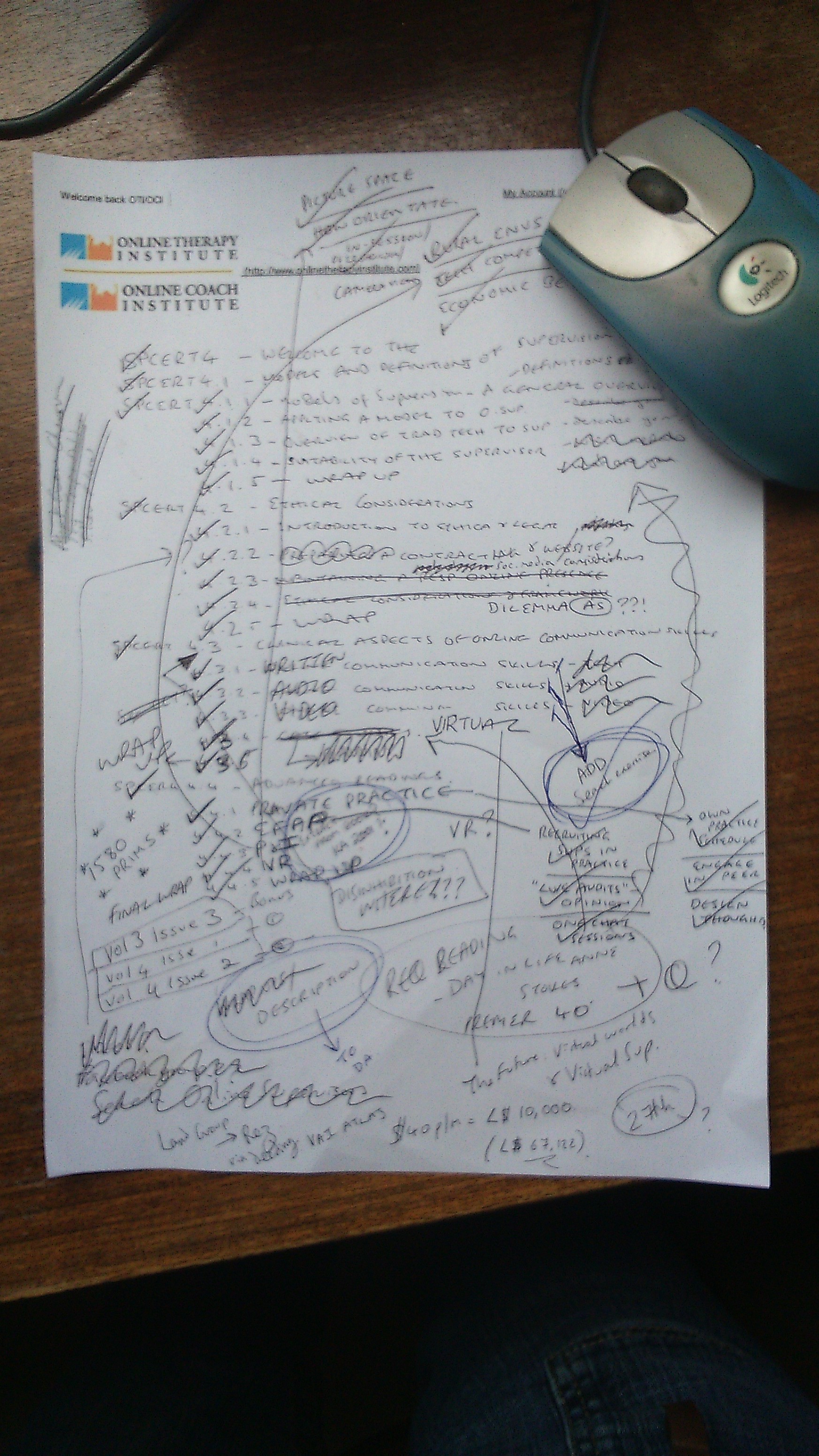
Sometimes when finishing up a course, I wonder how it got from the inside of my head to the training platform.  And then I realise I am generally staring at one sheet of A4 that shows me.  Look!

DSC_0107

What a mess, huh?  And yet every scribble on that one piece of paper (and I only EVER need one piece of paper) links to everything else in my head around that specific topic, from random thoughts to newspaper articles to online jokes to the academic papers that Google Scholar throws at me every morning.

Sometimes the human brain just stuns me. As Einstein said, “Computers are incredibly fast, accurate and stupid; humans are incredibly slow, inaccurate and brilliant; together they are powerful beyond imagination.”  Of course, he also said that technology has exceeded our humanity, but that’s a point I disagree with anyway 😉

I love technology.  That’s not a secret.  I also love my profession. Slamming those two things together in a coherent and ethically delivered way – not only educating others to advance confidently into the CyberCulture we now live and work in but also mentoring the innovators of the future to ensure the helping professions remain current and relevant in society – is my life’s work.

And if all you need is a pen and a sheet of paper like I often do, with no plug socket or wire in sight, remember that you are still using technology.  Douglas Adams taught me to think that way about chairs back in 1999. And in my world, you don’t get a better teacher than him.

🙂

« Previous Page
Next Page »

Lost?

Are you looking for counselling?...
Online or Offline

If you are in immediate distress or you feel suicidal and are in the UK then please visit the Samaritans.

In other countries, please contact Befrienders International.

Connect with Kate

Tweets

Tweets by @KateAnthony
© 2020 Online Therapy Institute Europe Ltd