Kate Anthony

OTI Europe Ltd | Consultancy, Personal Training and Research for Online Therapeutic Services

   
  • Home
  • About
    • CV
  • Speaker
  • Consult/Supervision
  • Online Therapy Training
  • CPD Specials
  • Coach Courses
  • Work with Young People?
  • COVID 19 Telehealth course
  • Blog
  • Contact
  • Work with DV?

First Steps to Training!

January 2, 2015 by Kate Anthony

281524-20141217

OK, the decorations are down, the fireworks are burnt out, and the new year resolutions are under way for the forseeable future at least. But have you thought of your Continuing Professional Development (CPD) needs as we charge into 2015? Do those needs include a feeling of how you really (really) ought to take your skills into the digital world that your clients inhabit but that you just haven’t been able to get around to yet? Would you like some guidance as to how easy this is even at an introductory level?

We’ve revisited our small courses about the world of Cyberspace and Online Therapy, and now offer them at a two-tier price level depending on just how much mentoring you desire from the experts in the field! We don’t pretend these are full trainings (see our wealth of that sort of thing here!), but they are there in case you want to know more about a specific technology, more about an area of Cyberspace you are unsure of, or even in case you want to dip your toes into our teaching methods and see how we roll!

These short courses can be taken with full lesson-by-lesson mentoring for just £150, or with no mentoring at all for just £75! You get full access to our resources and your CPD Certificate either way – we just want to be sure we meet all needs and all budgets!

And if you are ready to take your learning a step further at some point down the line, you can deduct the cost of these courses from our full CCF or PGCert trainings once completed if paying in full!

Start by checking out the list of small courses here, give Kate a shout if you have any questions at kate@onlinetherapyinstitute.com, and start 2015 by taking that first step into the world of online therapy!

 

Ordering Training À La Carte

December 15, 2014 by Kate Anthony

I’ve been having a think about how clients need varying levels of support in their lives at different times, and how online services can meet those needs.  Sometimes a forum with no interaction by the client is enough – they can learn from previous posts about how others coped in challenging times. Sometimes, the need steps up to receive communication from another human being about an issue, and this can be done through anonymous support forums or chat rooms. Perhaps an ongoing relationship would be helpful, and a less anonymous contract for therapeutic help would be useful from a trained counsellor or psychotherapist. Perhaps that contract can in turn be stepped up to include face-to-face sessions in-room as part of a blended care package.

In short – the levels of support and contact a person needs is a fluid thing!  So why not also apply this to training?ID-100207606

At the Online Therapy Institute, we pride ourselves on our attitude to training being a personal thing.  Each of our students gets one-to-one mentoring from myself or DeeAnna, depending on what the student wants or needs to learn about (and our training catalogue is extensive and diverse!). We build a personal relationship with each student to ensure their training needs are fully met, and we have found this to be the most enjoyable process in continuing professional development for both parties. Our training model lies in the training relationship being as central to the process as the therapeutic relationship will be to their future client base.  The key to learning is in the writing, and the essence of the learning being valuable comes from the personal mentoring that reflects and builds that learning into a living breathing part of a person’s professional identity.

Our Certified Cyber Facilitator and PGCert trainings are the gold standard of what we do, where students build relationships with us as expert trainers to meet professional needs on their journey to being an online practitioner. A more cost-considerate route is our streamlined versions of this, for example our Certified Cyber Therapist credential where you still get the mentoring relationship with me but at a faster pace!  And to make sure that our students feel happy with the chosen route, costs of any introductory courses are fully met if the student chooses to go on to the gold standard route.

But you know what? Just as sometimes a potential client will only need to surf anonymous forums or blogs for help with their mental health, sometimes a potential trainee just needs some building blocks to discover how much training they need or can afford.  This is why in 2015 I shall be offering my trainings à la carte!  This means you can receive the valuable teaching tools and resources we have developed over the years, but without the one-to-one mentoring.  You can always come back for more at no additional cost, and still get a certificate for CPD validation! It’s a win-win!

DeeAnna already offers this training model for our Certified Intuitive Practitioner course over at the Online AromaTherapy Institute if you want to see it in action – or drop me a comment below for updates in 2015!

🙂

[Image courtesy of Stuart Miles at FreeDigitalPhotos.net]

Coaching in the Digital Age

October 24, 2014 by Kate Anthony

Sometimes I feel I neglect the coaching part of me! 

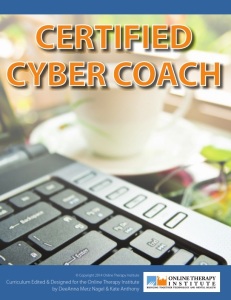
OTI_CertifiedCyberCoach_Cover_v1_001

It’s true that the majority of my work tends towards the counselling and therapy side: but am also a Certified Professional Coach (CPC) and an IAC Masteries™ Practitioner; maintain strong links with the Coaching Division of the British Association for Counselling and Psychotherapy as their LinkedIn membership officer and Specialist Advisor for Online Coaching; and am also a member of the Association for Coaching (AC) with the UK Chair of the organisation, Gladeana, being on our Faculty. The Online Coach Institute is also an International Association of Coaching (IAC) Coaching Masteries™ Authorized Licensee (having adapted them to online work), and DeeAnna and I are both on the Faculty of the excellent Institute for Life Coach Training (ILCT).

I’ve had cause to remember all this during this week because I’ve been working on our new credential – the Certified Cyber Coach course (CCC).  We have offered Online Coaching training as a Specialist Certificate for a while now, but it seemed to me while talking with my coaching colleagues that there is a need for a shorter course that simply introduces you to what is available within the realms of technology to enhance your work, alongside giving you the core information as to how to embrace electronic communication with clients and how to avoid the pitfalls that may lurk in doing so.

So I have built a hybrid course!  Less intense than our Specialist Certificate of 30 hours, but bigger than our basic Introduction to Online Coaching course (which offers 5 hours of learning).

By modelling the course on our popular Certified Cyber Therapist course structure of 15 hours, I’ve been able to include much more than the essentials of online behaviour, ethical considerations, and practicalities of using email, chat, telephone/audio and video with clients.  I’ve included the importance of having a Coaching Strategy for using technology in your work, information on Apps to both to manage practice and for your clients, and the exciting world of how Vision Boards look these days using technology!  I’ve added in valuable learning in taking up online methods for creative writing and the potential of a virtual coaching practice in a 3D environment.  To top all that off, it includes resources to help you plan and blend technological offerings into a rounded coaching practice ready for the client living and working in the digital age.

And, just for fun, the final lesson looks at the benefits that other coaches have found by taking their practice online, losing the daily commute and working more flexibly, and invite you to envision how your future practice will look when your clients are only a click away.

Don’t forget – each person taking the CCC will gain one-to-one mentoring from me to ensure your learning fits your individual needs as a coaching practitioner, whatever field of coaching you are in (including therapist as coach!).

Personally, I can’t wait to get started!  Email me if you fancy a chat about it, or head over the Coaching Courses page to see more!

🙂

Trolls .v. Abusers – Let’s Clarify a Bit

October 19, 2014 by Kate Anthony

I’ve posted about trolling before when I returned from a conference – and feel inspired to do so again having returned from another!  I went to a colleague’s workshop on CyberTrauma recently, and spent a very enjoyable day with counsellors, teachers, and other people with an interest in e-safety when it comes to working with children.  One of the most interesting debates was around trolling, and how this can be misunderstood in the context of the Internet as a result of media attention that aims to highlight the negative behaviours online that we encounter.

Here’s how I see it: it’s all down to the intention of the poster.

Cyberbullying is not trolling. Nor are flames or flamewars. Nor is downright online abuse of another human being or beings online when done anonymously through a public forum such as Twitter.  I do feel that the recent legal moves towards prosecution of those who engage in online abuse is a good thing, as I do feel that this addresses the incongruent gap between what is “real” abuse and what is “unreal” (as in: “it’s virtual so it doesn’t exist” – a phrase that has haunted my career when looking at the validity of online relationships, and which inspired one of my favourite self-penned articles back in 2001).

But trolling itself need not be abusive. It certainly can be irritating, frustrating, annoying, and create hours of time spent moderating forum posts, tweets, and blog comments when time could be better spent on something else. And it is true to say that it can often be abusive in nature and appear insulting (at best). But while trolling can be abusive, that does not mean that that is the central aim of trolling behaviour. The central aim of trolling is to lead the audience away from the intention of the initial poster.  It’s a smoke and mirrors exercise to draw attention to a new topic – one that is seemingly related but in effect creates a different conversation, ensuring the original point-of-vibluehaired_trollew is lost.  Take away the insults, threats, verbal abuse and (usually) bad spelling/use of caps and what you can see is an artform.  Done well, trolling is actually quite clever.  And a lot of the time, it’s actually quite funny (remember Rickrolling? That’s a classic example of trolling).

There are plenty of lists of the top examples of trolling over the last 25 years online, and plenty of articles discussing it (here’s a good simple one from Urban75).  I’m finding that within my work conversations it’s getting increasingly hard to distinguish between good old trolling and internet abuse, and that makes life difficult when training and offering informed opinion about how society could or should treats trolls, particularly within the field of mental health.

In the past few years the phrase “don’t feed the trolls” became a meme in itself – and when re-dressed as “don’t feed the online abusers” it makes perfect sense (although that attitude has changed in light of online abuse being (rightly) taken as a criminal matter rather than simply an annoyance).

But let’s be clearer in our definitions of what is trolling and what is online abuse – it’s going to make addressing mental health issues caused or exacerbated by types of online behaviour WAY easier.

🙂

« Previous Page
Next Page »

Lost?

Are you looking for counselling?...
Online or Offline

If you are in immediate distress or you feel suicidal and are in the UK then please visit the Samaritans.

In other countries, please contact Befrienders International.

Connect with Kate

Tweets

Tweets by @KateAnthony
© 2020 Online Therapy Institute Europe Ltd