Kate Anthony

OTI Europe Ltd | Consultancy, Personal Training and Research for Online Therapeutic Services

   
  • Home
  • About
    • CV
  • Speaker
  • Consult/Supervision
  • Online Therapy Training
  • CPD Specials
  • Coach Courses
  • Work with Young People?
  • COVID 19 Telehealth course
  • Blog
  • Contact
  • Work with DV?

On Being A Columnist

November 6, 2014 by Kate Anthony

I’ve been thinking about both my contributors to TILT Magazine and my own role as a columnist recently.  This was inspired by the departure of my good colleague Anne Stokes over at TILT Towers, who has been with us from the inaugural issue right up to the present day – that’s 20 columns submitted for our readers pleasure and education (or, to look at it differently, nearly a whopping 20,000 words!).  Anne’s topic was CyberSupervision, and I doubt we could have found a better UK expert to offer her words of wisdom (not to mention her being a pleasure to work with and her ability to meet deadlines like no other author I have come across in my time as Editor!).

Anne is handing her baton to another of our dear colleagues after the Winter 2014 issue of TILT to Cedric Speyer, another fine example of a CyberSupervisor we are very lucky to have on board, and perhaps with a very different style and passion – so while I am sad to say farewell to Anne, I’m also excited to welcome Cedric.

Our columnists receive no financial gain from their contributions, and nor have I over my years contributing regular columns for other editors.  I do try to be a regular columnist for only one publication at a time because of this (otherwise I can’t afford to feed the cat), but what is it about contributing our expertise to a wider audience that keeps us doing it for free?

Here are some thoughts:

We reach new audiencesCAW
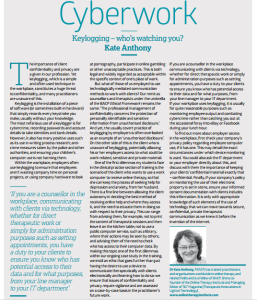
My current regular column is with the British Association of Counselling and Psychotherapy’s Workplace Division ( download it now! 13559_cyberwork CAW Autumn 2014). Not only does my work on Cyberculture and the impact of online services reach a new audience by doing this, I reach people who actively pay for a subscription and so are invested in reading the Journal.  Sure, they may skip over my part in it, but I am sure that the topic will surface in some part of their work one day and cause them to think “oh! I can find out more about this can’t I? – my journal covers it in every edition!”  I also receive a .pdf for my own distribution, as do all our columnists in TILT.

We receive new areas in which to market

Every columnist with a good editor will have a chance to provide the context in which they work in return for their wise words.  My by-line contains details of who I am, what I offer (and where), and how to get hold of me.  Readers of the journal are those involved in or contributing to the emotional and psychological health of people in organisations, including workplace counsellors, trainers, team leaders and welfare staff, occupational psychologists, HR managers and those with an interest in employee counselling services and skills.  How else could I each these people without investing in financial ways of marketing? And if your column makes it to the online version of the journal – as mine does – then that’s a whole new way of increasing your SEO!

We add to our publication lists

We all have a Curriculum Vitae or Résumé to maintain and our columns do just that.  Keep your links fresh from your up-to-date list of publications online and you have a handy resource to disseminate your work without resorting to a scanner or – dare I say it – a photocopier (that is SO 2008!).

Finally – you keep the Editors of the world very happy!

Really you do!  My role as co-Managing Editor of TILT Magazine is a labour of love, for all the reasons I outlined in an earlier post – and my regular columnists make my job 100 times better just by being willing and able to contribute with a cheery email when sending their work.   I am terrible with deadlines, and yet I rarely hear a peep of complaint about that!  So thank you to you all – past, present and future – for keeping me and my readers happier in our work!

🙂

Trolls .v. Abusers – Let’s Clarify a Bit

October 19, 2014 by Kate Anthony

I’ve posted about trolling before when I returned from a conference – and feel inspired to do so again having returned from another!  I went to a colleague’s workshop on CyberTrauma recently, and spent a very enjoyable day with counsellors, teachers, and other people with an interest in e-safety when it comes to working with children.  One of the most interesting debates was around trolling, and how this can be misunderstood in the context of the Internet as a result of media attention that aims to highlight the negative behaviours online that we encounter.

Here’s how I see it: it’s all down to the intention of the poster.

Cyberbullying is not trolling. Nor are flames or flamewars. Nor is downright online abuse of another human being or beings online when done anonymously through a public forum such as Twitter.  I do feel that the recent legal moves towards prosecution of those who engage in online abuse is a good thing, as I do feel that this addresses the incongruent gap between what is “real” abuse and what is “unreal” (as in: “it’s virtual so it doesn’t exist” – a phrase that has haunted my career when looking at the validity of online relationships, and which inspired one of my favourite self-penned articles back in 2001).

But trolling itself need not be abusive. It certainly can be irritating, frustrating, annoying, and create hours of time spent moderating forum posts, tweets, and blog comments when time could be better spent on something else. And it is true to say that it can often be abusive in nature and appear insulting (at best). But while trolling can be abusive, that does not mean that that is the central aim of trolling behaviour. The central aim of trolling is to lead the audience away from the intention of the initial poster.  It’s a smoke and mirrors exercise to draw attention to a new topic – one that is seemingly related but in effect creates a different conversation, ensuring the original point-of-vibluehaired_trollew is lost.  Take away the insults, threats, verbal abuse and (usually) bad spelling/use of caps and what you can see is an artform.  Done well, trolling is actually quite clever.  And a lot of the time, it’s actually quite funny (remember Rickrolling? That’s a classic example of trolling).
There are plenty of lists of the top examples of trolling over the last 25 years online, and plenty of articles discussing it (here’s a good simple one from Urban75).  I’m finding that within my work conversations it’s getting increasingly hard to distinguish between good old trolling and internet abuse, and that makes life difficult when training and offering informed opinion about how society could or should treats trolls, particularly within the field of mental health.

In the past few years the phrase “don’t feed the trolls” became a meme in itself – and when re-dressed as “don’t feed the online abusers” it makes perfect sense (although that attitude has changed in light of online abuse being (rightly) taken as a criminal matter rather than simply an annoyance).

But let’s be clearer in our definitions of what is trolling and what is online abuse – it’s going to make addressing mental health issues caused or exacerbated by types of online behaviour WAY easier.

🙂

Gaming online – when does it turn into a diagnosable psychiatric disorder?

October 1, 2014 by Kate Anthony

I have a special interest in this field, not only as part of my work in general but as an avid gamer myself.  With the exception of World of Warcraft (more on that later), I’ve pretty much run the gamut of gaming, from the Atari’s Pacman and Space Invader games back in the 70s right through the Legend of Zelda suite to the current rash of mobile and Facebook time-sucks (I use that term fondly) such as Bubble Witch Saga 2 and Candy Crush.

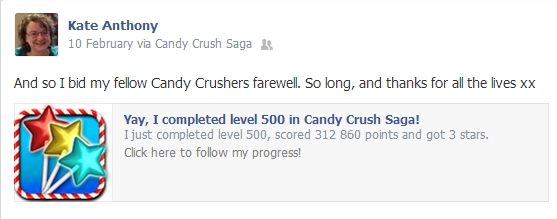
And I can truthfully say that Level 500 of CCS sucks:

cc

Recently a group of researchers tackled the controversial fact that the DSM-V includes non-substance addiction as a psychiatric diagnosis, in the journal Addiction.  This is a very welcome paper, not least because the DSM-V has pretty much sidelined the concept of general Internet addiction in favour of the specific behaviours conducted over the Internet. This has wide implications for various online addictions, including gambling, sex and virtual reality environments.

I found the recent showing in the UK of Web Junkie riveting – of course I was aware of the gaming boot camps in China, but watching the participants discuss their use of nappies to ensure they didn’t miss a minute of the game for their hygienic needs really brought home the huge problems gaming can cause.  These boot camps cost twice the parent’s average monthly income to attend – it is apparently never voluntary and often involves subterfuge to get the young people there in the first place.  Indeed, when a group of the boot camp members “escaped”, they headed straight for the nearest Internet Cafe to play for four hours before being “caught”.  Many cite combating loneliness as one of the main attractions.

I took one look at the game World of Warcraft when at a friend’s house, and vowed never to touch it.  The appeal of those beautiful graphics, the team-playing, the role-playing, the social side of like-minded people banding together to defeat obstacles and missions…  what’s not to like if you are an avid gamer?  My gaming colleagues and friends (you know who you are) have tempted me over the years – but WoW is a time-suck too far for someone who already has mild(ish) issues with online gaming.  I have almost (almost) sacrosanct boundaries in place for my gaming habit, playing only three in any one period (currently Bubble Witch Saga 2, Diamond Diggers Saga and the epic Tribez and Castlez, since you didn’t ask). These boundaries are necessary for reasons of both time (addiction/avoidance) and finance (in-gaming purchases to facilitate the addiction) – my time on Candy Crush Saga and Kitchen Scramble meant I eventually had to block them from all my devices (though if you’re ever stuck on a level, give me a shout 😉 )

There are complicated reasons for all addictions, and those within online gaming should not be ignored.  My current work is focusing on the innocent use of gaming to combat other addictions, not least gambling -after all, it’s only virtual money, right?  Wrong – my anecdotal research with gamblers show that online freemium play models are triggers, and a short step to being back in the offline casino or similar.  The DSM-V inclusion is welcome if only to bring the topic to the fore and allow academics to reach conclusions around potential treatment.

But let’s not forget the inclusion of the excellent concept of gamification in therapy!  For further reading, I’ll refer you to my colleague Mike at GamerTherapist.com – the guru of gamer affirmative psychotherapy.  Check out his blog to understand the positives gaming can bring to life experience – and happy (boundaried) gaming!

🙂

Certified Cyber Therapist – new approach, new course!

September 11, 2014 by Kate Anthony

At the Online Therapy Institute, our mission is to get as many trained online practitioners out there as possible, to protect the practitioner, the profession, and of course the potentially vulnerable client at the other end of the process.  This is in common with my fellow trainers here in the UK and internationally – we don’t mind which training you choose, as long as you seek training in being an online practitioner!

The classic phrase we all hear from our trainees is “I just didn’t know how much I didn’t know!”

But we also hear how practitioners – who let’s face it have already invested probably a lot of money in their core training – also feel that Continuing Professional Development (CPD) is a never-ending sink hole of expenditure. We empathise with that entirely – as practitioners ourselves, we know that our learning doesn’t end when we graduate with our counselling qualification.

Transferring your offline skills to an online environment isn’t just about knowing how to use electronic forms of communication.  For most of us, that is second nature now – and for the future therapists and clients it’s pretty much going to be in their blood from birth, metaphorically speaking.  I recently wrote an article on this, outlining how that tipping point hasn’t quite happened yet, but isn’t all that far off.

The point is, whether you want to practice online or not, your clients live in a digital world and deserve to have a therapist that is immersed in that world – understanding Cyberculture is the new first step to being an empathic practitioner (click here for an empathy-based in-joke).

But post-graduate training and CPD costs time and money 🙁

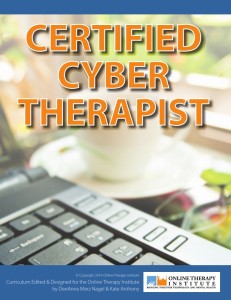
If you are thinking about investing in your ongoing development as a practitioner, and want to be an effective therapist in a fast-changing technology driven client world, you have probably seen our full BACP Endorsed trainings as a Certified Cyber FaciOTI_CertifiedCyberTherapist_Cover_v1 (1)_001litator (CCF) at the Institute.  But what if you are just not sure if the financial outlay is going to give you what you need?

DeeAnna and I have thought about this long and hard, and as a result have introduced a new introductory course called our Certified Cyber Therapist (CCT) course.  This cut-down version of our full training still gives you the one-to-one mentoring at every step that we are known for, but at a quarter of the both the cost and time needed.  If you are in the United States, you will have come to know the Distance Credentialed Counselor (DCC) certification as the ‘gold standard’- and OTI has been proud to have written the DCC curriculum, training thousands of practitioners. Now we bring you the absolute latest information through our own credential with our CCT course.

What’s more – if you take the introductory 15 hour CCT course – we’ll discount the money from the full CCF or PGCert training when you are ready for it!  It’s a win-win!  Many of our students pick up additional courses from us as and when time and money allow – and in between they get all the benefits of ongoing resources from us, as well as free subscription to TILT Magazine and now free access to the video library of our awesome colleagues at OnlinEvents!

Read more about the CCT here, and we look forward to mentoring you on your journey to being an effective and ethical online practitioner at whatever training cost suits you!

🙂

« Previous Page
Next Page »

Lost?

Are you looking for counselling?...
Online or Offline

If you are in immediate distress or you feel suicidal and are in the UK then please visit the Samaritans.

In other countries, please contact Befrienders International.

Connect with Kate

Tweets

Tweets by @KateAnthony
© 2020 Online Therapy Institute Europe Ltd